'Year of the Sheep' or 'Year of the Goat'?
Earliest version 2003 (Undated)
Under the Chinese system, 2003 is referred to as the Year of the Goat or the Year of the Sheep. Sometimes you'll find Year of the Ram, but never Year of the Ewe, Year of the Wether, Year of the Billy Goat or Year of the Nanny Goat -- obviously not dignified enough for the zodiac! So, which is correct, Year of the Sheep or Year of the Goat?
Officially, 2003 belongs to the sign 未 wèi. This is the eighth of the so-called twelve Earthly Branches 地支 dìzhī, part of a complex system of naming years, months, days, and hours developed by the ancient Chinese. Each Earthly Branch is identified with a different animal, the twelve animals of the Chinese zodiac. Wèi is identified with the 羊 yáng.
What is a 羊 yáng? Therein lies a problem. Look up a Chinese-English dictionary and you will find that yáng means 'sheep'. But yáng does not actually mean 'sheep' at all. To find the real meaning, you need to look up a monolingual Chinese dictionary. The definition of yáng is as follows (from Xiandai han'yu cidian):
A ruminant mammal, generally with horns on its head. Divided into a number of types, including 山羊 shānyáng, 绵羊 miányáng, 羚羊 língyáng, etc.
A little further investigation reveals that:
山羊 shānyáng ('mountain yáng') = goat
绵羊 miányáng ('cotton yáng') = sheep
羚羊 língyáng = gazelle
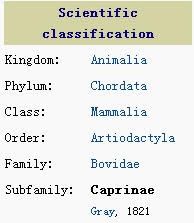
In other words, goats, sheep, and antelopes are all different types of yáng. Since only the goat and the sheep have been domesticated, the Chinese generally divide yáng into two types: shānyáng ('goats') and miányáng ('sheep').
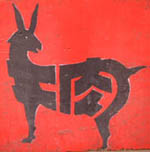
Given that yáng is a general term for both sheep and goats, it shouldn't be unthinkingly translated as 'sheep'. It could be either. For instance, 羊肉 yángròu or 'yáng meat' is commonly eaten in China. Many non-Chinese assume that yángròu is mutton. That's how it's defined in Chinese-English dictionaries. But go to one of the grassland areas where they catch and slaughter a 'sheep' for you to eat, and you'll be in for a surprise. The so-called 'sheep' is not of the woolly kind, it's a cute young goat with long straight hair. Goat meat may actually be more common than mutton in China, partly because it doesn't have the strong flavour that mutton has. The little sign below, from outside a small local restaurant in Hainan, is a graphic illustration of the possibility that your 羊肉 may be goat meat, showing the characters worked into what looks like the picture of a goat.
In other words, Year of the Goat and Year of the Sheep are equally correct because yáng covers both types of animal. The animal that goes with 羊年 yáng-nián ('year of the yáng') is often shown as a goat, but there is no ironclad rule about this.
The problem does not end here. The Japanese, Koreans, Vietnamese, and Mongolians have all borrowed the Chinese zodiac and use it to name the years. What is more, Japanese, Vietnamese, Mongolian, and Korean have separate words for sheep and goats, which means that they must make a choice: Is the zodiac animal a sheep or a goat? (I won't discuss Korean as it is beyond the scope of this site. I would be grateful for any information about Korean.)
The words for 'sheep' and 'goat' in Chinese, Japanese, and Vietnamese are as follows.
| Language | Sheep | Goat |
| Chinese | 绵羊 / 綿羊 miányáng |
山羊 shānyáng |
| Japanese | 羊 hitsuji |
山羊 yagi |
| Mongolian | Хонь khon' |
Ямаа yamaa |
| Vietnamese | cừu | dê |
The Japanese use the Chinese character 羊 to write the word hitsuji meaning 'sheep'. In other words, the character 羊 unequivocally means 'sheep' in Japanese.
This creates a dilemma -- how to write the word yagi meaning 'goat'? Since Chinese doesn't have a character for 'goat', the Japanese had to devise a different solution. They took the Chinese word for 'goat', i.e. 山羊 ('mountain sheep') and read it yagi. Just another of those little quirks of Japanese writing that is best explained by referring back to Chinese.
In the zodiac, 未年 quite naturally becomes hitsuji-doshi in Japanese -- the Year of the Sheep.
The Mongolians traditionally identify five major livestock animals: Horses (морь mor'), sheep (хонь khon'), goats (ямаа yamaa), cattle (үхэр ükher), and camels (тэмээ temee). Given that livestock are essential to the livelihood of the nomadic Mongolians, one would think that they would be more sensitive to differences among these animals than some of their neighbours. And to the Mongolians, 未年 is the Year of the Sheep (хонь khon').
What of Vietnamese? The Vietnamese pronunciation of the Eighth Earthly branch, 未, is mùi. Under the Vietnamese system mùi is unequivocally identified with dê (the 'goat'), and not with cừu (the 'sheep'). Thus, năm mùi (the 'year of mùi') is unmistakably the Year of the Goat.
What the above linguistic analysis doesn't answer is the historical question of how it got this way, in particular:
- Why did the Japanese assign the character 羊 to hitsuji ('sheep') and not yagi ('goat')? Was there some factor in ancient times that swung the pendulum that way -- perhaps yáng did mean 'sheep' in ancient China, or perhaps the Japanese simply felt more familiar with sheep than with goats?
- Why did the Vietnamese identify muì with the goat rather than the sheep, which it was theoretically possible to do? Is it because the Chinese generally identified 羊年 yáng-nián 'year of the yáng' with the goat and the Vietnamese simply followed suit?
I'm afraid that I have no answer to these questions. Any information gratefully received!