

An obvious and frequently-asked question is: Are the characters used in Japan the same as those used in China?
The short answer is yes. Chinese characters used by the Japanese derive from the same tradition as the Chinese, namely, the characters of the Classical language. In the same way that almost any English word is fair game for adoption into Japanese, virtually the entire corpus of traditional Chinese characters can theoretically be used.
However, anyone familiar with the two languages quickly realises that there are differences in the characters used. The main ones are:
- Number of characters in use: First, Japanese uses fewer characters than Chinese. While the Japanese adopted much Chinese vocabulary, they did not adopt everything. When they decided to restrict the number of kanji in use after the war, they were able to settle on 1,850 characters (since increased to 1,945) without undue problems. Even though many writers and academics find this number too restrictive and use some non-approved characters, the total number still does not come near the 3,000-4,000 minimum needed to function in Chinese. Japanese are aided by the fact that they can fall back on hiragana or katakana to write their language, unlike the Chinese who virtually use only characters.
- Non-classical characters in Chinese: Chinese contains some characters that have been specifically created for post-Classical Chinese words. For instance, 找 zhǎo 'look for' and 另 líng 'other' are relatively speaking fairly modern characters used to represent post-Classical vocabulary. They are not normally used in Japanese.
- Japanese characters (kokuji): Where the Japanese could not find an appropriate Chinese character to represent a Japanese word, they often created their own. Such characters are known as kokuji ('national characters') and a few have been included in the list of approved characters. Interestingly, the Chinese regard kokuji as part of the greater family of Chinese characters and include them in the larger, more comprehensive Chinese character dictionaries. Some examples:
Character Usage 込 込む komu 'to be packed'
込める komeru 'to put into, be included', 'to load', 'concentrate on'辻 辻 tsuji 'crossroads', personal name 働 働く hataraku 'work'
労働 roodoo 'labour'
- Standardisation of alternative forms: Many Chinese characters have several alternative forms. The Chinese and Japanese sometimes decided on different standard forms, e.g., the character for 'receive', which is 收 in Chinese and 収 in Japanese (the Chinese contains an extra stroke).
- Simplification: The simplification of characters after WWII in Japan and in the 1950s in China gave rise to divergences between the traditional characters (still used in Hong Kong and Taiwan), China's simplified characters, and Japan's simplified kanji. A Japanese character will sometimes be the same as the traditional form, sometimes the same as the Mainland form, sometimes the same as both, and sometimes different from both (see table below). In general, the simplification of characters in Japan was relatively mild compared to the drastic simplification on the Mainland.
Traditional Chinese Simplified Chinese Japanese Meaning Comment 家 家 家 'house, home' Not simplified 國 国 国 'country, nation' Simplified the same way in Mainland China and Japan 間 间 間 'space, between' Simplified in Mainland China but not Japan 佛 佛 仏 'Buddha' Simplified in Japan but not Mainland China (uncommon) 傳 传 伝 'to transmit, story' Simplified differently in Mainland China and Japan Substitution of characters: In simplifying the characters the Japanese also restricted the number to be used, disallowing the use of some characters in education and the media. In order to follow these restrictions, abolished characters are either written in hiragana or replaced with a different character of similar meaning. This results in some less-than-satisfactory compromises.
Original Characters Meaning Pronunciation Substitution of hiragana Substitution of different character 隠蔽 'concealment, hiding' inpei 隠ぺい -- 改竄 'alteration, tampering' kaizan 改ざん -- 腐爛 'ulceration, decomposition' furan 腐らん 腐乱 車輛 'carriage, car' sharyō - 車両 In such cases, the abolished character is present in spirit but not in form, like a 'ghost limb' that has been amputated but feels as though it is still there. Since hiragana are normally used to write verb endings, substituting hiragana for characters can be confusing. For instance, 腐らん furan looks as though it should be read kusaran, a literary or dialect pronunciation meaning 'not rot' -- the exact opposite of 腐爛! Moreover, replacing the disallowed character 爛 ran 'soft, rot, fester, messy' with the approved character 乱 ran 'be confused, in chaos' results in some loss of meaning. 'Rotten and festering' is more accurate than 'rotten and confused'.
Differences in the meanings of characters: Partly because of changes in meaning on both sides, some characters have different meanings in Chinese and Japanese. To take a simple example, the verb 走 zǒu meant 'to run' in Classical Chinese. It still does in Japanese as 走る hashiru, but the meaning has changed to 'to go' in modern Mandarin. From the Chinese point of view, the Japanese usage has a quaint Classical feel to it.
READINGS:
When the Japanese borrowed Chinese characters, the aspect that was to have the most far-reaching consequence was the fact that they were used for both:
- Words (or forms) borrowed from Chinese -- the character was used with its original pronunciation and meaning intact.
- Native Japanese words -- characters came to be identified with the native word having the closest meaning.
This results in the most striking feature of Chinese characters in Japanese, i.e., the fact that most of them can be read in at least two ways, one known as the on reading, the other as the kun reading. This is a key concept in understanding the structure of the modern Japanese vocabulary.
The on reading is fairly easy to grasp: it's used for that large segment of the Japanese vocabulary that was originally taken from Chinese. The on reading thus approximates to the original Chinese pronunciation, e.g., the character 火 'fire' has the on reading ka, based on the Chinese pronunciation of the time (the modern Mandarin pronunciation is huǒ). The character 山 'mountain' has the on reading san, zan or sen, pronounced shān in modern Mandarin Chinese. Of course, the on readings are now rather different from the modern Chinese pronunciation. This is due to various reasons -- borrowing from different dialects, adaptation of the pronunciation to fit the Japanese language, and changes on both sides over the past millennium. But the similarities are quite obvious once allowances are made, and linguists have even used the Japanese pronunciation as an aid in reconstructing the ancient Chinese pronunciation.
Because the on readings roughly follow the Chinese pronunciation, the form of many characters gives a hint of the pronunciation, just as they do in Chinese. For instance, the following characters that have 白 as a phonetic all have similar on readings:
Character On reading Meaning 白 haku, byaku 'white' 樫 byaku 'oak' 伯 haku 'uncle' 舶 haku 'ship' 拍 haku, hyō 'hit, beat' 迫 haku 'press, urge, force'
Multiple on readings:
One feature of the on readings is that many characters have more than one possible on reading. For instance, the character 日 'sun, day' (rì in Chinese) has two on readings: nichi and jitsu. It is read nichi in 一日 ichi-nichi 'one day' and jitsu in 本日 honjitsu 'this day'. This derives from the fact that the Chinese writing system was borrowed not once but at least twice during Japan's history. The first time resulted in what are known as the Go readings, particularly associated with Buddhism (generally pre-Tang) and the second was more secular in inspiration, resulting in the Kan readings (Tang dynasty). Other, less important readings also exist but these are isolated borrowings and do not form a coherent system like the Go and Kan readings. For an example of such a reading, see gyōza. The following table shows some examples of Go and Kan readings.
Character Go reading Kan reading 日 'sun, day' nichi jitsu 精 'spirit, essence' shō sei 美 'beauty' mi bi 役 'campaign, service, role' yaku eki 西 'west' sai sei 建 'build' kon ken 大 'large' dai tai 経 'sutra, pass through' kyō kei
The Kan readings were eventually adopted as the officially correct version and were supposed to supersede the Go readings, but it didn't quite happen that way. Many Go readings continued in use, especially in Buddhist contexts. Confusing as the existence of two readings may be, the day might yet have been saved if only the language had kept the two systems separate, i.e., by constructing individual words solely Go readings or solely with Kan readings. Again, it didn't happen that way: there are plenty of words in Japanese where one character is read in Go and the second character character is read in Kan. Needless to say, figuring out the correct reading can sometimes be a problem!
As in Chinese, characters form 'compound words', e.g., 火山 kazan 'fire' + 'mountain' = 'volcano'. In fact, the on readings have taken on a life of their own, like Latin roots in English. Many Chinese-style character compounds were actually created by the Japanese in the modern era to translate Western terminology. They have since been re-exported to China, resulting in a huge corpus of vocabulary that is shared by Chinese and Japanese. This vocabulary can be read by speakers of both languages, although with different pronunciations. This is a great bond that links the two languages, despite the fact that they belong to entirely different language families.
What truly complicates the Japanese writing system is the use of Chinese characters to write native Japanese words. This custom originally arose as a way of reading and understanding Chinese texts. Each character was glossed with the Japanese word closest in meaning. Eventually a system grew up whereby Chinese characters were assigned specific Japanese readings, known as kun readings. For instance, it became customary for the character 火 ('fire') to be read hi, which is the Japanese word for 'fire'. Similarly, 山 ('mountain') came to be read yama, the native Japanese word for 'mountain'. Most (but not all) characters now have a kun reading in addition to an on reading.
The assignment of Japanese readings to Chinese characters gave rise to several problems.
1) Phonetic element is useless: Because the kun reading is native Japanese, the phonetic element of the character is useless for guessing the pronunciation. To take the earlier example using the phonetic element 白, the kun pronunciations are completely unpredictable, unlike the regular pattern of the on readings:
| Character | Kun Reading | Meaning |
| 白 , 白い | shiro, shiroi | 'white' |
| 樫 | kashiwa | 'oak' |
| 迫る | semaru | 'press, urge, force' |
2) Lack of fit between vocabularies: Since there is not a perfect fit between the Chinese and Japanese vocabularies, complications arose in assigning kun readings.
In some cases a single Japanese word corresponded to several different Chinese words. For instance, the Japanese verb noboru meaning 'climb' or 'go up', corresponded to three Chinese words, as shown in this table:
Japanese word Chinese equivalents Meaning Japanese writing のぼる
noboru上 shàng 'go up' (in general) 上る noboru 昇 shēng 'rise (into the sky)' 昇る noboru 登 dēng 'climb (a mountain)' 登るnoboru
The Japanese word noboru is now written with three different characters. For the general meaning 'go up', it's written 上る (note: る is hiragana indicating the verbal ending -ru). In the meaning 'rise (into the sky)', it's written 昇る. In the meaning 'climb (a mountain)', it's written 登る. This system generally works quite nicely, but sometimes even the Japanese find it difficult to figure out which character is most appropriate (The confusion that this can engender is detailed in Jack Halpern's page on what he quaintly calls 'Japanese homophones'.)
The reverse also occurred. Where a single Chinese word corresponded to more than one Japanese word, the same character was used for several different Japanese words. For instance, the Chinese word 上 shàng ('above, on top of, go up') corresponded in meaning to ue meaning 'above' or 'on top of', kami meaning 'above' 'higher', agaru meaning to 'go up', ageru meaning 'to give' (respectfully), and noboru 'to go up'. As a result, 上 is now used to write all these words.
Japanese word Meaning Chinese equivalent Japanese writing (multiple kun readings) うえ ue 'above' or 'on top of' 上 shàng 上 ue かみ kami 'above' 'higher' 上 kami あがる agaru 'to go up' 上がる agaru あげる ageru 'to give' (respectfully) 上げる ageru のぼる noboru 'to go up, climb' 上る noboru
In the case of verbs with multiple readings, hiragana sometimes provides a clue to pronunciation, e.g., agaru is written 上がる (上 + -garu) and ageru is written 上げる (上 + -geru).
The divide in the Japanese vocabulary
The division between on and kun readings represents an important divide in the Japanese vocabulary. Since words read with kun readings are native Japanese words, they tend to be related to everyday life. (Alternatively, they may be associated with older, more poetic Japanese words). On readings are generally used for more formal, official, or scientific vocabulary. The difference is similar to that found in English between everyday words such as 'fire', and words using Latin or Greek roots such as 'ignite' (Latin ignis = 'fire') or 'pyrotechnics' (Greek pur = 'fire').
Taking the character 火 'fire' as an example, the kun reading hi is used in words with humble backgrounds like:
Word Meaning 火 hi 'fire' 火鉢 hi-bachi 'fire' + 'pot' = 'brazier' 火種 hi-dane 'fire' + 'seed' = 'live coal' 火花 hi-bana 'fire' + 'flower' = 'sparks' 下火 shita-bi 'down' + 'fire' = 'dying down'
The on reading ka is generally found in more technical, formal, academic, or official words like:
Word Meaning karyoku
'fire' + 'power' = 'thermal power' hakka
'initiate' + 'fire' = 'ignition' 'release' + 'fire' = 'arson' kasoo
'fire' + 'funeral' = 'cremation' senka
'war' + 'fire' = 'the fires of war' shukka
'come out' + 'fire' = 'break out'


On readings usually form a part of compound words as only a relatively small number can stand as single words in Japanese.
Once the principle of on readings and kun readings is understood, the system falls into place and it is much easier to decide which reading is required. However, there are still many complications that must be overcome in order to read Japanese.
Despite the neat division between the two segments of the vocabulary, in practice it has been impossible to keep them completely apart. There has been some interesting crossover between on readings and kun readings.
a) Words that have been converted from kun to on
The word 出火 shukka looks like a Chinese word. In fact it was created as a fancy form of the ordinary Japanese expression 火が出る hi ga deru ('a fire breaks out'). In Chinese, 出火 chū huǒ means 'to get angry'.
立腹 rippuku is another word that is not found at all in Chinese. It was created from the Japanese expression 腹が立つ hara ga tatsu (literally, 'abdomen stands up') 'to get angry'.
Some words that were originally native Japanese have also been converted completely to on readings, e.g. 返事 henji, which was originally the Japanese word kaerigoto, a word that no longer exists. The compound 返事 is not found in Chinese.
b) Mixtures of on and kun
Sometimes the crossover between the two systems gives rise to mixed readings:
Word Reading of First Part Reading of Second Part juu-bako
'tiers of lacquered boxes'juu (on reading)
'place one on top of the otherhako (kun reading)
'box'te-hon
'copy, example'te (kun reading)
'hand'hon (on reading)
'book, example'Some words can be read with either a kun or an on reading, e.g.,
'town' in place names can be read either choo (on reading) or machi (kun reading), depending on the locality.
('water' + 'bird' = 'waterfowl') is normally read with the kun reading mizu-dori but can also be read with the on reading suichoo. In many cases it is simply a matter of knowing the word, knowing how it's pronounced, and knowing how it's written -- pretty much like learning English spelling.

Other complicatons
There are several practices in the writing system that complicate matters even further.
- Chinese character compounds -- not just single characters -- are sometimes
used to write native Japanese words, especially the names of plants and
animals.
 (purple + sun/yang
+ flower) is a Chinese word meaning 'hydrangea'. The hydrangea is known
as ajisai
in Japanese. To write ajisai,
Japanese takes over the compound ,
assigning the reading ajisai to the entire
compound without reference to the individual components (This is often
found in the writing of bird names -- see The
Writing of Japanese Bird Names Using Chinese Characters).
(purple + sun/yang
+ flower) is a Chinese word meaning 'hydrangea'. The hydrangea is known
as ajisai
in Japanese. To write ajisai,
Japanese takes over the compound ,
assigning the reading ajisai to the entire
compound without reference to the individual components (This is often
found in the writing of bird names -- see The
Writing of Japanese Bird Names Using Chinese Characters).
Similarly, the compound ryuukoo,
meaning 'popular/widespread', can be used to write
the purely Japanese verb hayaru
'to be popular, widespread' -- not forgetting the hiragana verb ending:
ryuukoo,
meaning 'popular/widespread', can be used to write
the purely Japanese verb hayaru
'to be popular, widespread' -- not forgetting the hiragana verb ending:
 .
. - Various irregular readings have developed over the centuries and must
be learnt individually, e.g.,

 ('one day') is read tsuitachi when it means
'first of the month' (usually written across the page as
('one day') is read tsuitachi when it means
'first of the month' (usually written across the page as 
 ).
).
 'lack + extend' is
quite irregularly read as akubi 'to yawn'. Place
names and personal names are a particularly rich source of idiosyncratic
readings (for instance, see Hard-to-read
place names in the Kansai region).
'lack + extend' is
quite irregularly read as akubi 'to yawn'. Place
names and personal names are a particularly rich source of idiosyncratic
readings (for instance, see Hard-to-read
place names in the Kansai region).
The result of the way that the Japanese have borrowed and applied Chinese characters to their own language has given rise to considerable complexity and a heavy burden for the learner of Japanese.
After all this complexity, the saving grace of Japanese, at least in comparison with Chinese, is that it has a way of writing the pronunciation of words, the kana syllabaries. As luck would have it, the Japanese have decided to use not one, but two different syllabaries to write their language.
The kana (hiragana and katakana) first developed because Chinese characters could not properly represent the grammatical elements and verb endings of Japanese. Originally certain Chinese characters were used to write these elements phonetically. These characters were simplified over time to yield the hiragana and katakana syllabaries. As the name 'syllabary' suggests, the syllabaries are used to represent combinations of consonants and vowels, not single sounds. Except for certain details such as the method of lengthening vowels, hiragana and katakana are completely parallel alphabets.
At the outset, the kana and the pronunciation of the language were fairly much in sync, but they inevitably drifted apart over time. By the 19th century, kana usage had become
confused due to changes in pronunciation.
A concerted attempt was made to reconstruct, restore, and enforce the original
usage of ancient times, which was called the 'historical kana usage'.
While this may have been correct in historical terms it was divorced from the modern pronunciation and placed a burden
on modern-day learners, resulting in calls
for reform. After World War II, kana usage
was reformed to reflect the modern pronunciation. Two redundant letters,
 wi
and
wi
and  we
in their hiragana form, were abolished.
we
in their hiragana form, were abolished.
Hiragana: The hiragana script (written
 hi-ra-ga-na
in hiragana) is a cursive script still mostly used for:
hi-ra-ga-na
in hiragana) is a cursive script still mostly used for:
- Particles, e.g.,
 ga,
ga,
 no,
and
no,
and  ha
(the latter being pronounced wa).
ha
(the latter being pronounced wa). - The endings on verbs, e.g.,
ru,
 ta,
ta,  masu, etc. Owing to the nature of the syllabary,
part of the root is often included in the ending. For instance, the verb 'to
write' is kaku, which changes form as kakimasu,
kakeba etc. The root is obviously kak-,
but the kana includes the final k- sound
in the ending, not the root:
masu, etc. Owing to the nature of the syllabary,
part of the root is often included in the ending. For instance, the verb 'to
write' is kaku, which changes form as kakimasu,
kakeba etc. The root is obviously kak-,
but the kana includes the final k- sound
in the ending, not the root:  ka-ku,
  ka-kimasu, etc.
 - Grammatical words such as
 kono 'this'.
 - Words where there are no suitable Chinese characters or the Chinese characters
are too difficult for ordinary use, e.g.
 ringo 'apple' is normally written in hiragana
as
ringo 'apple' is normally written in hiragana
as  .
.
Children first learn to read and write in hiragana.
Katakana: The katakana script (written
 ka-ta-ka-na
in katakana) is a blocky-looking syllabary now mainly used for
writing:
ka-ta-ka-na
in katakana) is a blocky-looking syllabary now mainly used for
writing:
- Foreign words, e.g.,
 depaato 'department store',
  kurejitto kaado 'credit card',
 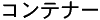 kontenaa '(freight) container', etc. In the past
few decades, Japanese has subjected itself to a massive influx of foreign
words, resulting in a profusion of katakana.
kontenaa '(freight) container', etc. In the past
few decades, Japanese has subjected itself to a massive influx of foreign
words, resulting in a profusion of katakana. - Scientific names of plants and animals, e.g.,
 zou 'elephant',
  tobi 'kite', even
  hito 'person' = 'homo sapiens'. All these words
are usually written in Chinese characters for non-scientific use.
hito 'person' = 'homo sapiens'. All these words
are usually written in Chinese characters for non-scientific use. - Onomatopoeic words, e.g.,
 gata gata 'rattling/rickety sound'. (These words are similar to English
'thud', 'splash', and 'biff', but have a much wider range of application in
Japanese than English).
gata gata 'rattling/rickety sound'. (These words are similar to English
'thud', 'splash', and 'biff', but have a much wider range of application in
Japanese than English).
Furigana/rubi: With the heavy use of
characters in the past, it was common for printed texts to indicate the pronunciation
in small hiragana or katakana above the Chinese character, e.g.,
 noboru.
This practice, known as furigana or rubi, is no longer so
common but is still found in comics, books written for children, and academic
or other texts using difficult characters.
noboru.
This practice, known as furigana or rubi, is no longer so
common but is still found in comics, books written for children, and academic
or other texts using difficult characters.
The full table of hiragana and katakana symbols can be found at Hiragana & Katakana. More hiragana and katakana tables can be found in the Links.
Could Kanji be replaced with Kana?
With such a complicated system of Chinese characters, the question naturally arises: Can't the two kana syllabaries, hiragana and katakana, be used in place of the characters? Theoretically the answer is yes, but in fact the syllabaries still play only a supplementary role in the Japanese script, much as they have from the start.
Aside from the weight of tradition and custom, there are several good reasons why hiragana have failed to replace the characters.
1) Economising on space: The kana take up considerably more space than characters. Nihon Keizai Shinbun ('Japan Economic Newspaper', one of Japan's major newspapers) is
in characters and
in hiragana.
2) Visual aid in reading: Characters create a focus when reading text. Usually the main content words are in characters and the endings are in kana. Since Japanese does not put spaces between words, this is highly useful in scanning text. A short phrase such as Tookyoo made 'as far as Tokyo' is easier to analyse into 'noun + particle' when characters are used:
. In this case,
Tookyoo provides a visual focus while the particle
made represents the attached grammatical element. This effect is lost if hiragana only are used:
.
3) Conveying a meaning: Characters suggest a meaning to the reader. This not only helps give meaning to a text (for example, the characters for Tookyoo mean 'eastern capital'), it also helps disambiguate words with similar pronunciations. For example,
hooka has a number of meanings, which become clear when written in characters:
'arson',
'be released from class',
'cannon fire', etc.
4) Link between on and kun vocabulary: Characters act as a bridge between vocabulary using on and kun readings. For instance,
kuruma 'car' and
jidoosha 'automobile' are completely unrelated words in hiragana, but when written in characters as
and
respectively, the character
Similarly, characters may also act as a bridge among different on readings. For instance, Keihin is a word used in expressions like 'the Keihin district' or 'the Keihin expressway'. It is an abbreviation of 'Tokyo-Yokohama'. This is not at all apparent until Keihin is seen in characters as
. It then becomes immediately clear that:
is from
is from
Yokohama. This features a switch from the kun reading hama to the on reading hin.
The makeshift nature of the Japanese writing system means that the same word may be written in different ways. While this can be a source of great confusion, it can also offer writers a unique stylistic choice. The same word may be written in either Chinese characters, hiragana, katakana, or Roman letters depending on the situation, the type of text, and the writer's preference. A few examples of the variation that can be found:
- In many everyday structural words, there is a choice between hiragana
and Chinese characters. For example,
 aru 'to have, to exist' can be written
  or
or  (both pronounced
aru, but meaning 'to have' and 'to exist' respectively).
The word kono
'this' can be written
(both pronounced
aru, but meaning 'to have' and 'to exist' respectively).
The word kono
'this' can be written  kono. Hiragana is modern standard usage,
but with word processors, which make it easy to summon up difficult characters,
the character versions are making something of a comeback. Men are more
likely to use characters in such cases. Heavy use of hiragana traditionally
tends to be identified with women's writing.
kono. Hiragana is modern standard usage,
but with word processors, which make it easy to summon up difficult characters,
the character versions are making something of a comeback. Men are more
likely to use characters in such cases. Heavy use of hiragana traditionally
tends to be identified with women's writing. - The use of hiragana after verbs and associated nouns can show some
variation in usage. The verb mitsumoru 'to give
a cost estimate' is usually written
 .
The noun mitsumori, meaning 'cost quotation',
may be written
.
The noun mitsumori, meaning 'cost quotation',
may be written  ,
,
 , or
, or  ,
the latter being preferred for its brevity in the word
,
the latter being preferred for its brevity in the word  mitsumori-sho '(written) cost quotation'. Correct
usage of hiragana after verbs has been subject to periodic changes
by the language and educational authorities.
mitsumori-sho '(written) cost quotation'. Correct
usage of hiragana after verbs has been subject to periodic changes
by the language and educational authorities.
- The word koohii 'coffee' is normally written
in katakana as
 koohii, but where an old-fashioned, genteel
feeling is desired the old character rendition
koohii, but where an old-fashioned, genteel
feeling is desired the old character rendition  koohii is sometimes used. Of course, the English
spelling 'coffee' is also quite common in advertising and Japanese have
no hesitation in reading it as koohii (see variants
in signs and advertising for specific examples in action).
koohii is sometimes used. Of course, the English
spelling 'coffee' is also quite common in advertising and Japanese have
no hesitation in reading it as koohii (see variants
in signs and advertising for specific examples in action). - The word fakkusu may be written in katakana
as
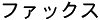 or using English
spelling as
or using English
spelling as  . The
latter appears more business-like and international.
. The
latter appears more business-like and international. - Sometimes katakana will be preferred to hiragana or characters
in order to set a word off from the rest of the sentence or because the
characters involved are awkward, unclear, or uncommon. E.g.,
 (
( ) tsuke
'bill',
) tsuke
'bill',  (
( )
boke 'idiot, stooge in stage act',
)
boke 'idiot, stooge in stage act',  (
( ) hage
'bald', and
) hage
'bald', and  (
( )
tsubo 'pressure point/acupuncture point'. This
frequently occurs with short two-syllable words, which appear 'punchier' written
in katakana.
)
tsubo 'pressure point/acupuncture point'. This
frequently occurs with short two-syllable words, which appear 'punchier' written
in katakana. - Choosing different characters can convey different meanings. For instance,
the Japanese word aoi meaning 'blue/green' can
be written with several Chinese characters, including

 ,
,
 ,
,
 ,
and
,
and  ,
each indicating a different kind of 'blue' or 'green' - the blue of the sky,
the blue of the sea, the green of young leaves, the 'green' of a pallid face,
etc. A Japanese author can indicate exactly what kind of 'blue/green' he or
she is talking about by using a different character for aoi.
,
each indicating a different kind of 'blue' or 'green' - the blue of the sky,
the blue of the sea, the green of young leaves, the 'green' of a pallid face,
etc. A Japanese author can indicate exactly what kind of 'blue/green' he or
she is talking about by using a different character for aoi. - A more interesting trick is to write a word in Chinese characters but indicate
with small lettering above that it should be read in a completely different
way. For instance, in translating the Harry Potter books, (see Harry
Potter in CJV), Yuko Matsuoka takes the character
 ryuu or tatsu, meaning
'dragon' in the Oriental sense, and gives it the English reading 'dragon'
by merely adding the katakana for doragon
above the character:
ryuu or tatsu, meaning
'dragon' in the Oriental sense, and gives it the English reading 'dragon'
by merely adding the katakana for doragon
above the character:  .
The beauty of this device is that familiar characters can be given completely
different readings, i.e., it's possible to write one thing and mean another.
It's also possible to use unfamiliar foreign words and explain their meaning
in Chinese characters.
.
The beauty of this device is that familiar characters can be given completely
different readings, i.e., it's possible to write one thing and mean another.
It's also possible to use unfamiliar foreign words and explain their meaning
in Chinese characters.
An idea of the flexibility and variation that is possible with the Japanese writing system can be seen in this look at signs and advertising in Japanese.
For more information on the Japanese writing system, see Links. See also the Chinese Writing System and the Vietnamese Writing System.
